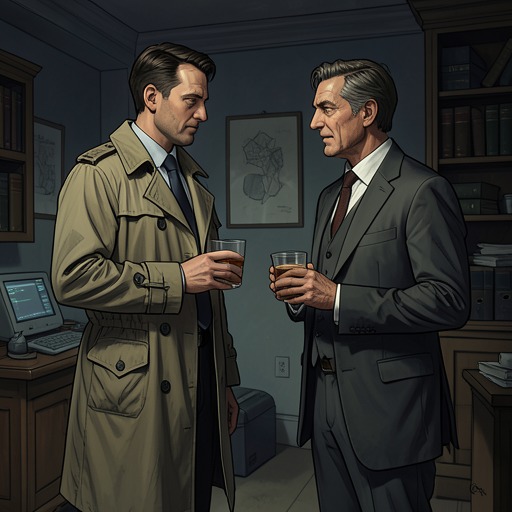
Hauser
Naked LunchHauser is a veteran officer on the City Narcotic Squad whose practiced routines make him both a formidable presence and, for a moment, vulnerable to William Lee’s escape. Their last encounter begins as an ordinary pickup and ends in Hauser’s death; afterward, Lee finds that Hauser and his partner O’Brien have disappeared from the department’s records and from the present. The episode turns police procedure into a trap that Lee escapes only by killing the men sent to arrest him.
Identity and Background
Hauser has served on the City Narcotic Squad for twenty years. Lee, himself a heroin user of sixteen years, remembers him as the hard man of a police partnership: O’Brien played the con man, while Hauser supplied force. Lee describes the pair as a vaudeville team, a contrast between O’Brien’s sociable approach and Hauser’s physical intimidation. Hauser might hit a suspect before speaking, ostensibly to break the ice; the violence is already part of his conversational method.
The officers are not presented as interchangeable agents of the law. Lee judges that they were not bad as laws go, and distinguishes O’Brien as the more approachable of the two. But that limited regard does not make their work benign: Hauser carries out arrests with his gun already drawn, using its presence to control the suspect psychologically and to prevent a dash for the toilet, sink, or window. His authority rests not only on his badge but on the anticipation of force.
The Arrest at the Hotel Lamprey
The arrest begins with a call to Hauser while he is eating breakfast. A lieutenant directs him and O’Brien to pick up Lee, William Lee, at the Hotel Lamprey, Room 606, and to bring in all books, letters, manuscripts, or other written material. The instruction not to search the room sits beside the unusually broad demand for Lee’s papers. Hauser remembers Lee and asks what the books have to do with the pickup, but the lieutenant tells him simply to carry out the order.
Hauser and O’Brien enter with a pass key that works even when the door has been locked from inside. Lee is preparing his morning injection; on the table lie heroin, a syringe, alcohol, cotton, and a glass of water. O’Brien greets Lee with familiar ease, but Hauser has his gun out and tells him to put on his coat. Lee asks whether he can take a shot first, pointing out that the drugs are already there as evidence. Hauser eventually permits it, warning Lee that he had better deliver. The allowance gives Lee the time he needs, though the officers remain suspicious.
While Lee injects himself, O’Brien sits on a chair arm smoking an Old Gold and gazing out the window. Hauser handles his Colt detective special and searches the room. He opens the closet and glances inside, then turns back to Lee and warns him not to try to fool them about Marty. The brief lapse is decisive: Hauser has not yet inspected Lee’s suitcase, where Lee’s gun is hidden, but he is close enough to discover it.
The Shooting and Escape
Lee has prepared a deception. After injecting the heroin, he fills the syringe with alcohol. He flicks a thin stream into Hauser’s eyes, then drops to the floor and reaches for the suitcase. Hauser fires as Lee takes the gun, but the bullet strikes the wall behind him. From the floor, Lee fires two shots into Hauser’s exposed abdomen, where his vest has ridden up and revealed a strip of white shirt.
O’Brien reaches for the gun in his shoulder holster. Lee braces his gun wrist with his other hand; because the weapon’s hammer has been bled off, it can only be fired double action. He shoots O’Brien in the forehead, below the silver hairline. The description makes the encounter more than an anonymous shootout: O’Brien’s hair has turned grey since Lee last saw him, about fifteen years earlier, when O’Brien made Lee’s first arrest. Hauser’s attack and death occur in the same compressed burst of action as O’Brien’s, but Lee’s account singles out the earlier familiarity with the two officers and the long history behind the arrest.
Lee immediately takes what he needs, sweeping notebooks into a briefcase with his equipment, drugs, and ammunition. He puts the gun in his belt, walks into the corridor while putting on his coat, and leaves by the self-service elevator. The desk clerk and bellboy are running up the stairs, but Lee crosses the empty lobby and gets out to the street. He knows his chance of escape is poor, yet judges any chance better than being subjected to experiments. Hauser’s routine pickup has become the point at which Lee chooses lethal resistance over capture.
Aftermath and Narrative Significance
The shooting does not lead to an ordinary police pursuit. Later, Lee calls the narcotics department and asks to speak to O’Brien, then to Hauser. The responses deny that either man is in the bureau; when Lee insists, the exchange leaves him confronting an absence rather than a search for two missing officers. He hangs up and takes a taxi out of the area, realizing that he has been occluded from space-time.
Lee understands the change as permanent exclusion: he will never again have a key or a point of intersection. He imagines himself relegated, along with Hauser and O’Brien, to a landlocked junk past where heroin still costs twenty-eight dollars an ounce and a user can find yen pox in a Sioux Falls Chinese laundry. Hauser thus persists after his death as part of Lee’s vanished past, not as a continuing pursuer. The contrast between the immediate physical violence of the hotel room and the later bureaucratic denial gives the episode its larger force: the arrest is both a failed police operation and a boundary crossing that separates Lee from the time in which Hauser’s authority could reach him.